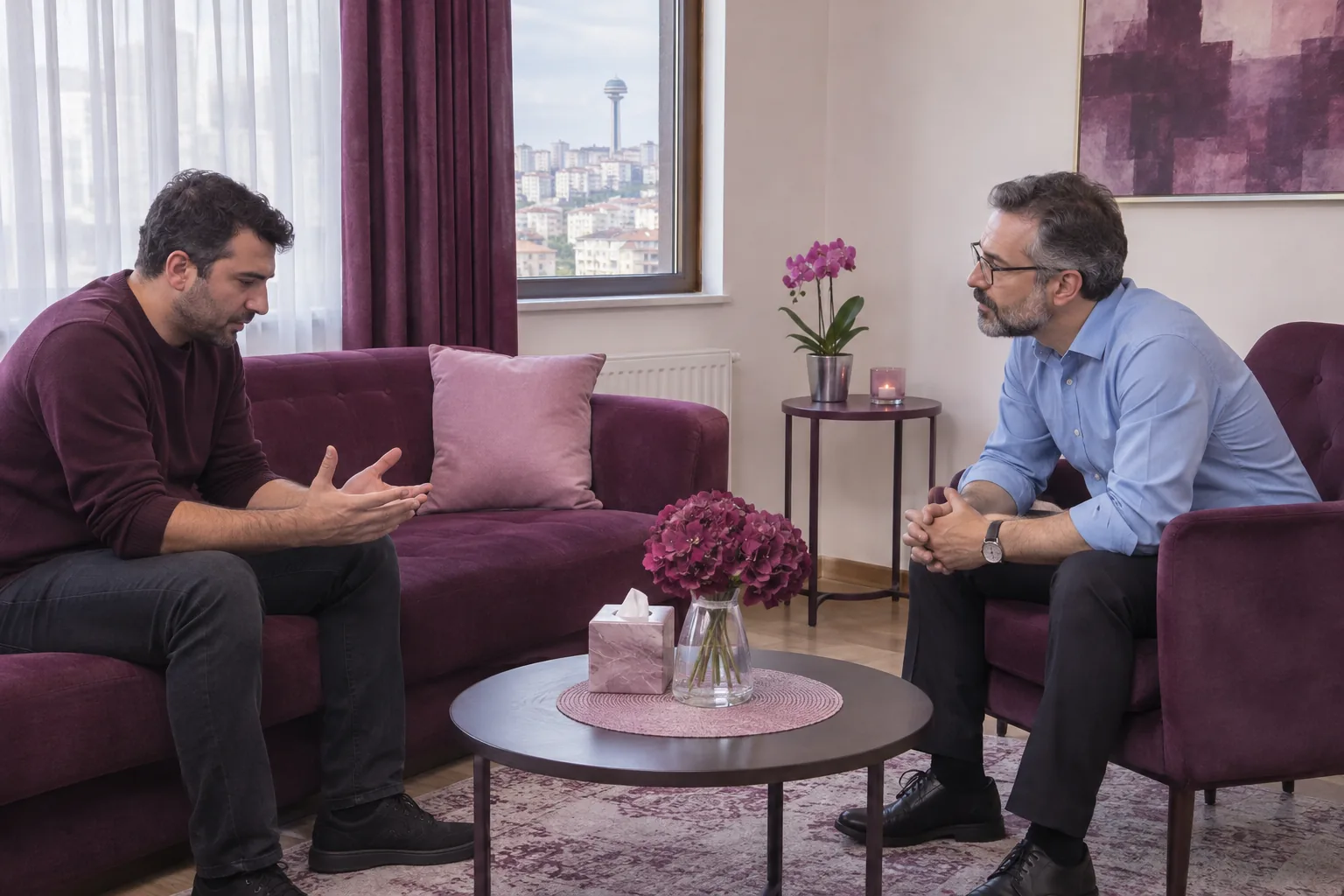
The hardest part of starting therapy is not knowing what comes next. Below we describe the usual course of couples work; family and parenting sessions follow a similar path.
Two lines, one process.
When the lines run side by side, you are together; when they part, each of you is in your own session.
One partnerThe other partnerTogether
Together
First call
15 minutes, by phone. One of you calling is enough, but we will ask whether the other partner is willing to come.
Together
First joint session
75 minutes. Why now, what you would like to change, how we will work and the confidentiality agreement.
One partner
Separate session
50 minutes, one partner: their family background, their place in the relationship, what they hope for.
The other partner
Separate session
50 minutes, the other partner: the same framework.
Together
Joint sessions
Weekly in the first month, then every two weeks; the argument cycle, repair, closeness.
Together
Mid-point review
Around the 6th session: what has changed, what has not, how shall we go on?
Together
Closing and follow-up
The last session is planned in advance; an optional follow-up session three months later.
Week 1
First joint session
In the first session you are both in the same room. Each of you explains in your own words why you have come; we do not step in to correct anyone.
In the last ten minutes we talk about how we will work: how often we meet, the cancellation policy, confidentiality and how we will handle what is shared in separate sessions.
Weeks 2–3
Separate sessions
Each of you comes once on your own. This is where we talk about what is hard to say in front of your partner, what you bring from your own family and what you want from the relationship.
Separate sessions are not there to "win over" one side; they are there so that we hear both of your stories in full.
Weeks 4–12
Joint sessions and homework
In joint sessions we look at the cycle of your most repeated argument: who pursues, who withdraws, when it escalates.
Between sessions we suggest small experiments: an evening walk, a ten-minute talking time, an agreement to pause an argument.
Around session 6
Mid-point review
At a certain point we stop and look together: what has changed, what has stayed the same? Continuing, meeting less often or moving to a different kind of session is a decision we make together.
We agree on "secrets" from the start.
In a separate sessionWhat you tell me stays in my own session notes; I do not pass it on to the other partner.
Common groundIn that case, we look together for a way for you to share it yourself.
ButIf information that directly affects the work is kept hidden, couples therapy may not be able to continue.
We share this approach in writing in the first joint session; we do not move on to separate sessions until you have both agreed.
Online sessions
The same process works online. Couples can join from the same screen or from two separate places; sessions are not recorded.
Referral to another professional
If we think one of you needs individual or psychiatric support, we will say so plainly and refer you to colleagues we trust.
Ending
You can stop therapy whenever you wish. If possible, we suggest planning a final session and talking together about where you have got to.
Questions about the process
QuestionMy partner doesn’t want to come. Can I start alone?
Answer
Yes. You can start with relationship-focused individual sessions. If your partner later wants to join, we will consider moving on to couples work together; to keep neutrality, the couples process is usually led by our other therapist.
QuestionHow many sessions does couples therapy take?
Answer
It varies from couple to couple. Most processes take 10–20 sessions. Around the sixth session we hold a review and decide together how to continue. We do not promise results within a set number of sessions.
QuestionDoes the therapist take sides?
Answer
No. In sessions we talk not about who is right but about where you are both stuck. If one of you feels alone, we ask you to say so in the session; keeping neutrality is part of our job.
QuestionIs couples therapy suitable if there is violence in the relationship?
Answer
If there is ongoing physical or severe psychological violence, couples therapy is not suitable; safety comes first. In an emergency call 112; for domestic violence you can call the ALO 183 social support line in Turkey. We will talk about this openly in the pre-call and refer you to appropriate support.